3D Printing
Formlabs for Jewelry in 2026: Printers, Casting Resins and Supplies
A practical jewelry guide to Form Studio 1, Form 4, True Cast and Castable Wax: compare printer compatibility, resin tanks, washing and curing before you buy.
· 12 min read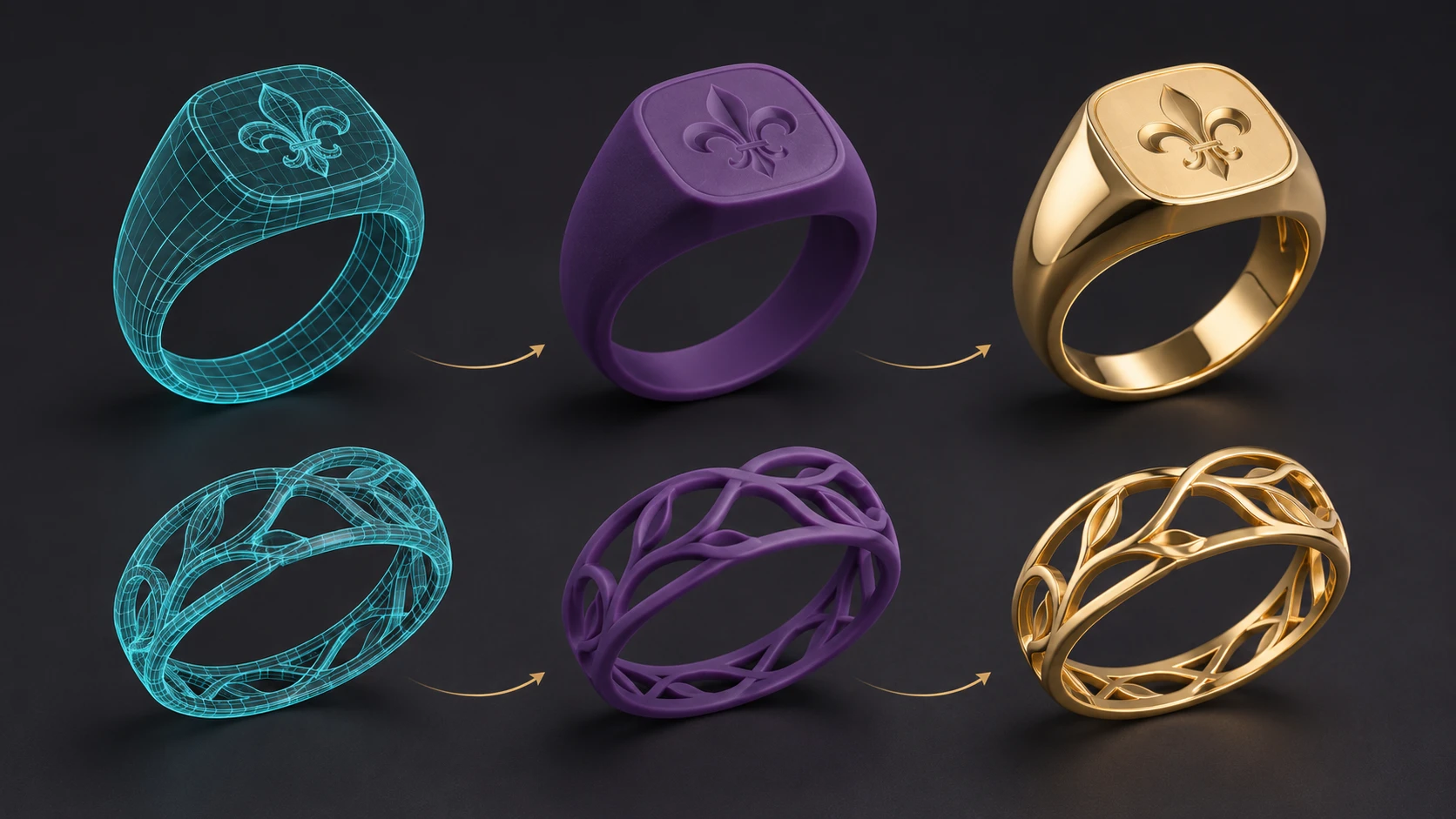
Affiliate disclosure: JewelModel is a Formlabs affiliate through Awin. We may earn a commission from qualifying purchases through links marked "affiliate link" in this article.
Updated 26 November 2026. This is an independent buying and workflow guide based on Formlabs documentation, not a hands-on printer or casting test. The cover is an AI-created conceptual illustration of CAD, a resin pattern and finished jewelry; it does not show actual Formlabs print results.
A printer is only one part of a jewelry casting workflow. The more consequential decision is often the combination of geometry, resin, tank, preparation and casting process. A thin filigree ring and a heavy signet may need different materials even when they come from the same CAD library.
Formlabs now offers a less expensive entry point with Form Studio 1, alongside the established Form 4 family. For jewelers, the useful question is what each system can do with the casting material you intend to use. This guide covers the recent changes, the resins worth considering, and the supplies that belong in a realistic workshop budget.
For a broader introduction to the process, start with our guide to 3D printing and lost-wax casting for jewelry.
What is new for jewelry makers in late 2026?
Form Studio 1 is the principal new printer in this guide. Formlabs announced it on 14 October 2026, with global shipping announced for 16 November. Its launch price in the United States was $699 before tax. The same launch introduced the Alpha Resin family and Form Studio Wash+Cure. Prices, packages and availability can change; check your regional store before ordering. Source: Formlabs launch announcement.
True Cast Resin is an existing material with new Studio 1 support. The resin dates to June 2025. PreForm 3.64.2, released on 23 October 2026, added a 50-micron True Cast setting for Studio 1. This distinction matters: a new printer profile is useful news, but it is not a new resin formulation. Source: PreForm release notes.
Form 4 and Form 4L remain relevant professional options. They were introduced in 2024, so this article treats them as current alternatives rather than newly launched 2026 printers.
Choose the jewelry workflow before the machine
Start with the part you want to make and the result your casting partner needs.
| Your main task | A sensible starting point | Check before buying |
|---|---|---|
| Medium or heavier rings, medallions and similar patterns | True Cast Resin | Wall thickness, available print profile and the casting shop's process |
| Fine filigree, thin details and lightweight patterns | Castable Wax Resin | Printer-specific cartridge, tank and supported settings |
| Visual design models and presentation prototypes | A suitable modeling resin, such as Alpha Model | Whether you need appearance, handling strength or a casting pattern |
| Larger casting patterns | Evaluate Clear Cast with the relevant workflow | Internal geometry, lattice preparation and casting requirements |
| A master used to make a rubber mold | Evaluate a suitable master-model material | The mold temperature, pressure and material's processed properties |
These are starting points for material selection. A file's appearance in a CAD viewport cannot demonstrate that it will print, survive handling and cast successfully. Before committing a valuable batch, test a representative model with the people who will carry out the later stages.
Form Studio 1, Form 4 or Form 4L?
Form Studio 1: an accessible route to a supported casting material
Form Studio 1 uses Formlabs' Low Force Display technology, an MSLA process. Its build volume is 200 × 125 × 235 mm and its pixel size is 35 microns. True Cast belongs to its validated material selection.
That makes Studio 1 worth examining for a small workshop whose intended workflow fits True Cast. It is not necessary to buy the widest material ecosystem if you have one well-defined job. Conversely, a lower entry price does not make every resin or casting process equally suitable.
Pay attention to the difference between compatible hardware and validated settings. Studio 1 includes Open Material Mode, but the broader resin choices can require a Studio Resin Tank Pro and user-developed settings. A product listing that names the printer does not by itself establish a ready-to-use jewelry workflow.
Explore Form Studio 1 and current packages (affiliate link)
Form 4: a broader professional material platform
Form 4 also uses an MSLA/LFD process; it is not a laser-SLA printer. Its 200 × 125 × 210 mm build volume accommodates desktop work, while the broader validated material selection is relevant to workshops that alternate between different tasks.
Do not rank these printers by pixel size alone. Pixel size is a specification, not a measurement of the dimensional accuracy or surface finish of your finished ring. Compare the profiles available for the exact resin, the handling process and a representative sample.
For a studio that already has a functioning Form 4 workflow, Studio 1 is not automatically an upgrade. The decision should follow capacity or workflow needs.
Explore Form 4 (affiliate link)
Form 4L: capacity when production justifies it
Form 4L expands the build volume to 353 × 196 × 350 mm. It deserves consideration when a workshop has enough parts or larger patterns to use that space.
Before moving to a larger machine, identify the actual bottleneck. If staff spend most of the day removing supports, preparing flasks or finishing castings, more printing capacity may simply move the queue downstream. Estimate the work required to handle an entire build, not just the number of rings that fit on it.
Explore Form 4L (affiliate link)
Casting resins: match the material to the geometry
True Cast Resin for medium and heavier jewelry
Formlabs positions True Cast for medium and heavy jewelry, medallions and other casting patterns up to 5 mm thick. Current product specifications list Form 4, Form 4B and Form Studio 1. It is not the manufacturer's preferred choice for wire filigree.
The preparation instructions matter as much as the purchase decision. Follow the current guidance for warming and mixing the resin, washing and drying the printed part. The True Cast usage guide says post-curing is not required, but recommends it to reduce casting defects. Use the prescribed process for your equipment instead of assuming that any UV cycle is equivalent.
For a signet or medallion, check the actual thickest section. A broad face can conceal a thick solid volume that needs reconsideration before printing.
Check True Cast Resin and printer compatibility (affiliate link)
Castable Wax Resin for delicate details and filigree
Castable Wax Resin is a 20% wax-filled material aimed at lightweight jewelry and fine structures. Filigree, thin patterns and detailed settings are the kinds of geometry for which it is worth evaluating. Formlabs advises against treating it as the default for large, bulky patterns.
The current store offers printer-series variants. Select the cartridge for your machine rather than assuming that every bottle or cartridge with the same material name is interchangeable.
After the prescribed wash and complete drying, Castable Wax does not require post-curing. Formlabs notes that additional curing may cause slight shrinkage or distortion. This is a useful example of why a longer processing sequence is not always better. Source: Castable Wax usage guide.
For Studio 1, verify the current profile and tank requirements before choosing Castable Wax. Do not confuse an Open Material Mode possibility with the validated True Cast route.
Choose Castable Wax Resin for your printer series (affiliate link)
Clear Cast Resin for a different scale of pattern
Clear Cast is relevant to larger casting patterns and workflows that use lattice preparation. It should not be presented as a universal replacement for either True Cast or Castable Wax.
If your work extends beyond small jewelry into larger ornaments, discuss the pattern's internal structure and burnout requirements with your casting partner before choosing the material. Changing the resin alone does not resolve the challenges of a thick pattern.
Review Clear Cast Resin (affiliate link)
Modeling and mold-making materials serve different jobs
The new Alpha materials provide options for models and prototypes. A visual model can help evaluate proportion and presentation, but a general modeling resin should not be treated as a castable material.
High Temp Resin is a separate option to evaluate for heat-resistant master-model applications, including suitable mold-making processes. It is not a castable resin to substitute into a direct burnout workflow. Check the mold's temperature and pressure against the material's properties after the required processing.
For jewelry work, decide whether you need a disposable casting pattern or a master that survives making a mold. Those are different purchases.
Review High Temp Resin for master-model applications (affiliate link)
Tanks and supplies: buy for the exact printer and material
A replacement tank is a practical purchase, but the printer name and tank type must match.
- Studio 1 with True Cast: Formlabs lists the standard Studio Resin Tank as suitable. You do not automatically need Tank Pro for this combination.
- Studio 1 with Open Material Mode: Tank Pro is required. Consult the current material instructions before assuming a broader resin will work with default settings.
- Form 4/4B: use the Form 4 Resin Tank. It is not a replacement tank for Studio 1. Form 4 tanks do not include a mixer; check whether you need one separately.
Keeping a dedicated tank for each resin type can make material changes more manageable and reduce the need to empty and clean a tank each time. Label the material and record its history. Replace components according to their condition and manufacturer guidance rather than an invented monthly schedule.
The Studio tank guide is the useful reference for standard versus Pro requirements.
Check the Form 4 Resin Tank (affiliate link)
Also budget for the less visible part of resin work: suitable gloves and eye protection, cleaning materials, containers, filters and the handling and disposal arrangements specified by the material's safety documentation. A printer-only budget is not a complete operating budget.
Washing and curing: follow the resin, not a generic checklist
A castable resin has its own preparation instructions. Keep those instructions available at the workstation, particularly when switching between materials.
Form Studio Wash+Cure combines washing and UV curing in one unit. It has no heater. Form Cure offers heated post-curing, so the two should not be treated as interchangeable for every prescribed material cycle. Form Wash is a separate washing option.
This does not mean every jewelry studio needs the most expensive processing package. Castable Wax does not require a post-cure, while True Cast has its own recommendation. Choose equipment that can carry out the process you actually need.
- Review Form Studio Wash+Cure (affiliate link)
- Review Form Wash (affiliate link)
- Review Form Cure (affiliate link)
Treat cleaning, drying and handling as part of production planning. A printer finishing a build does not mean its patterns are ready to invest immediately. Follow current resin instructions and the safety data sheet; do not transfer a schedule from a different material simply because the parts look similar.
Can you use True Cast with a non-Formlabs printer?
Formlabs publishes recommended True Cast settings for selected third-party machines, including models from Anycubic, Elegoo and Phrozen. This is relevant if you already own a resin printer and want to evaluate a casting material before buying another machine.
The list is model-specific. An entry for one Elegoo or Phrozen printer is not approval for the entire brand. Confirm the exact printer, material format available in your region and downloadable profile. Then validate the process with a representative test part.
Check Formlabs' supported third-party printer settings.
A practical path from a jewelry file to a casting
Use a small, repeatable validation job before scaling up:
- Inspect the design. Check units, dimensions, wall sections, delicate elements and a usable closed mesh. Establish which features are essential to preserve.
- Choose the material for that geometry. Decide whether you are making a casting pattern, a presentation model or a mold master.
- Confirm the whole combination. Printer, resin version, cartridge, tank, build platform and software profile should agree.
- Prepare orientation and supports. Think about accessible support removal and the surfaces that must remain clean. A visually convenient orientation may create finishing work later.
- Print a representative sample. Include the thin or thick features that make the job difficult; a simple calibration object may not reveal those problems.
- Wash, dry and process it as specified. Record the settings so a successful result can be repeated.
- Agree the casting process. Coordinate investment, spruing and burnout with the casting shop and material documentation.
- Inspect the metal result. Record dimensions, defects and finishing effort before approving a larger run.
There is no single burnout schedule in this guide. The investment, flask, geometry, resin and casting equipment all matter; a recipe copied without that context is not a validated production process.
You can explore jewelry STL files and ring designs on JewelModel. Check each model's details and make any production-specific adjustments before printing. A catalog rendering is a design reference, not proof of a successful print or casting.
What belongs in your first purchase?
For a small workshop, begin with one coherent setup: the printer or existing machine you intend to use, one appropriate casting resin, its compatible tank and the required preparation process. Confirm the result before expanding into several materials.
For an established studio, start with the problem you are solving. Running out of resin, needing a dedicated tank for another material and lacking enough build capacity are different needs. Buy the item that addresses the constraint.
The useful measure is the cost and effort of an acceptable finished casting. Include material, consumables, handling time, failed attempts and finishing—not just the price of the printer or a liter of resin. A more expensive consumable may be reasonable if a measured workflow saves work; it is not automatically better because it costs more.
Product links in this guide are affiliate links where labeled. Choose the material and equipment that fit your work, and check the manufacturer's current compatibility and regional price before ordering.
Official references and update notes
The buying links above lead to the relevant Formlabs product pages through Awin. The documentation links below are direct reference links.
- Form Studio 1 launch announcement
- PreForm release notes and new material profiles
- Resin formulation history
- True Cast Resin usage instructions
- Castable Wax Resin usage instructions
- Studio 1 resin tank types
- True Cast settings for selected third-party printers
Product availability and validated profiles can change. This guide reflects the documentation reviewed on 26 November 2026.