From Digital to Dazzling: The Ultimate Guide to 3D Printing in Jewelry
· 6 min read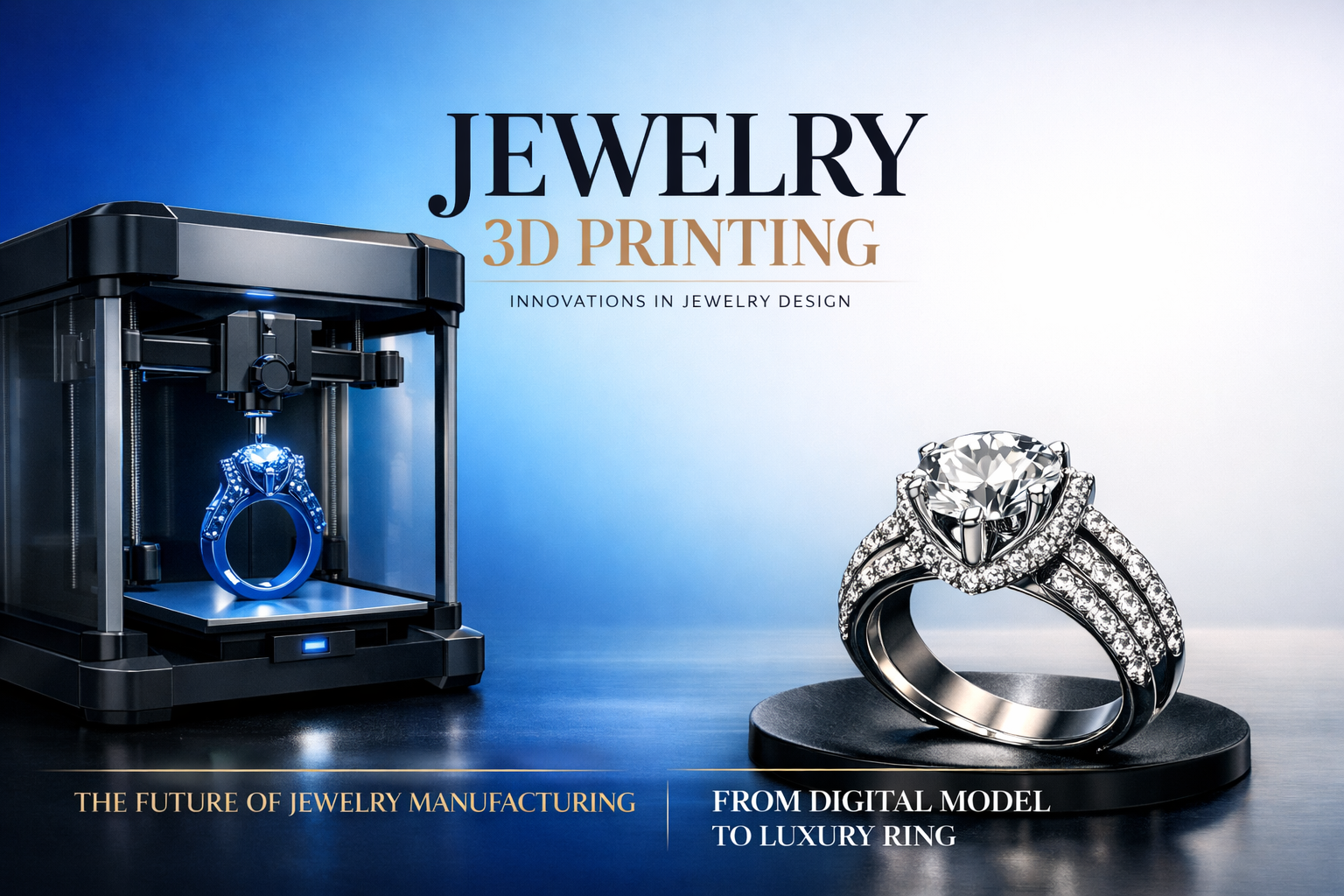
The Digital Revolution in a Timeless Craft
The art of jewelry making is a tradition steeped in history, precision, and meticulous craftsmanship. For centuries, artisans have carved, molded, and cast precious metals by hand. Today, technology is not replacing this artistry but elevating it. 3D printing, also known as additive manufacturing, has emerged as a transformative force, enabling unprecedented complexity, speed, and precision in jewelry production.
This digital workflow begins not with wax or metal, but with an idea brought to life in CAD (Computer-Aided Design) software. This guide will walk you through the entire process, from a digital blueprint to a stunning, wearable piece of jewelry.
From CAD File to Physical Model: The Blueprint
Every 3D printed piece of jewelry starts as a digital file. Designers use specialized CAD software like Rhinoceros 3D, MatrixGold, or Blender to create a detailed three-dimensional model. This digital model is the master blueprint, defining every curve, prong, and intricate detail with mathematical precision.
Once the design is finalized, it is exported into a format that a 3D printer can understand. The most common file types for this are:
- STL (Stereolithography): This is the industry standard, representing the surface geometry of a 3D object using a mesh of triangles.
- 3DM: This is the native file format for Rhinoceros 3D, a hugely popular software in the jewelry design world. It contains more detailed geometric information than an STL file.
These files are the crucial link between the digital design and the physical world. For jewelers looking to expand their collections without designing every piece from scratch, countless hours can be saved by sourcing high-quality, ready-to-print files from a professional marketplace. You can explore a vast library of stunning designs in our marketplace.
How Does 3D Printing Work for Jewelry?
With a digital file ready, the 3D printing process can begin. Unlike traditional subtractive manufacturing (where material is carved away), 3D printing is an additive process. The 3D printers build the object layer by microscopic layer from the bottom up.
For jewelry, the most common technologies use a photopolymer Resin as the primary material. A light source—either a laser or a digital projector—selectively hardens the liquid resin layer by layer, slowly building the model. The magic ingredient for jewelers is the type of resin used: Castable Resin or Castable Wax.
These materials are engineered with a specific purpose: to burn away cleanly and completely at high temperatures, leaving zero ash or residue. This property is absolutely critical for the next stage in the production process: investment casting.
The Bridge to Traditional Craftsmanship: Lost-Wax Casting
This is where cutting-edge technology meets a centuries-old technique. Lost-wax casting (also known as investment casting) is the process of creating a metal object from a master pattern. Traditionally, this pattern was hand-carved from wax. Today, the high-resolution 3D printed model serves as a perfect, digitally precise master pattern.
Here is how the process works:
- Mounting: The 3D printed castable resin or wax model is attached to a wax "tree" with other pieces.
- Investment: The tree is placed inside a metal flask, and a plaster-like slurry called "investment" is poured around it, completely covering the models.
- Burnout: Once the investment hardens, the entire flask is placed in a high-temperature kiln for several hours. During this burnout cycle, the castable resin or wax model vaporizes completely—it becomes "lost." This leaves a perfect, highly detailed negative cavity of the jewelry piece inside the hardened investment mold.
- Casting: Molten metal—such as gold, silver, or platinum—is then poured (or vacuum-injected) into the mold, filling the cavity left by the vaporized model.
- Divesting: After the metal cools and solidifies, the investment mold is broken away, revealing the raw metal casting of the jewelry.
- Finishing: The raw casting is then cut from the tree, cleaned, and handed over to a bench jeweler for the final polishing, stone setting, and finishing touches. The result is a piece of jewelry that started as a digital file.
Key 3D Printer Technologies and Manufacturers
The market for jewelry 3D printers is sophisticated, with several key technologies and 3d Printer manufacturers leading the way. The choice of printer often depends on the desired level of detail, production volume, and budget.
Stereolithography (SLA)
SLA printers use an ultraviolet laser to precisely cure liquid resin. They are renowned for producing models with exceptional surface finish and fine details. A major player in this space is Formlabs, whose printers are celebrated for their ease of use, reliability, and high-quality castable resin formulations.
Digital Light Processing (DLP)
DLP is similar to SLA but uses a digital light projector to flash and cure an entire layer at once. This often results in faster print times compared to SLA. Many manufacturers produce excellent DLP printers suitable for jewelry applications.
MultiJet Modeling (MJM) / Material Jetting
This technology operates like an inkjet printer, but instead of ink, it deposits micro-droplets of material (like Castable Wax) that solidify to form the object. These printers are prized for their incredible accuracy and ability to create the most intricate and delicate designs. The industry leaders here are:
- 3D Systems: Their Projet line of printers are workhorses in the jewelry industry, known for producing high-fidelity wax patterns.
- SolidScape: A subsidiary of Stratasys, SolidScape printers are considered the gold standard for high-end, bespoke jewelry, producing exceptionally detailed wax models with a clean burnout.
Advantages of 3D Printing in a Jeweler's Workflow
Integrating a digital workflow offers significant advantages over purely traditional methods:
- Unmatched Design Freedom: Create complex, organic, and intricate geometries that would be impossible to carve by hand. Check out these amazing STL files for jewelry.
- Rapid Prototyping: Print a non-castable resin model in a matter of hours for a client to try on. This allows for immediate feedback on fit and design before committing to precious metal.
- Efficient Customization: Easily modify a CAD file to personalize a design for a client, making bespoke jewelry more accessible and profitable.
- Precision and Replication: Once a design is perfected in CAD, you can reproduce it flawlessly every time. This is invaluable for creating matching sets like wedding bands or earring pairs.
- Reduced Material Waste: As an additive process, you only use the wax or resin needed to build the model, unlike carving, which generates significant waste.
The Future is Digital
Embracing 3D printing does not mean abandoning the art of jewelry making. It means enhancing it. The fusion of CAD design, high-resolution 3d Printers, and timeless lost-wax casting techniques allows jewelers to push the boundaries of creativity and efficiency.
Whether you are a designer creating your own models, a jeweler looking for unique pieces to offer your clients, or a manufacturer scaling production, this technology is central to the future of the industry. Exploring a marketplace of ready-made files for custom rings or other jewelry can be the perfect first step into this exciting digital frontier.