FlashForge WaxJet WJ51C: Is This the Most Interesting Jewelry 3D Printer of 2026?
· 5 min read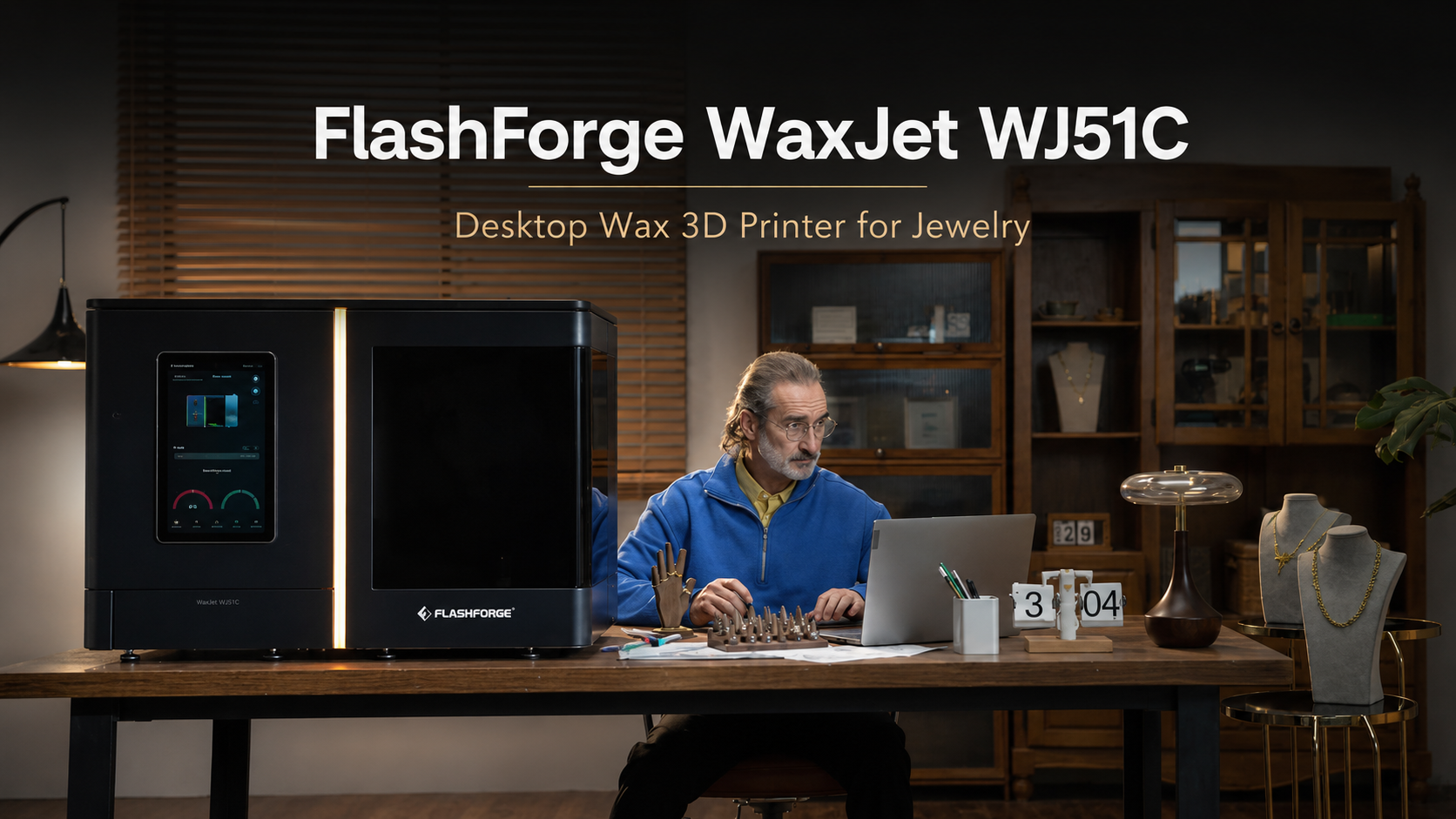
For years, professional wax 3D printing for jewelry has largely belonged to casting houses and larger manufacturers. High-end wax jetting systems offered excellent surface quality and predictable investment casting, but their size and price made them difficult to justify for independent jewelry designers and smaller workshops.
The FlashForge WaxJet WJ51C, launched in 2026, is an interesting attempt to change that equation.
FlashForge describes the WJ51C as the world's first “desktop industrial wax 3D printer.” That wording should be taken as the manufacturer's positioning rather than an independently established industry title, but the underlying idea is important: the machine combines MultiJet Printing (MJP), real castable wax, soluble wax supports and 15-micron layers in a substantially smaller and less expensive system than traditional industrial wax printers.
For jewelry designers, small casting workshops and digital jewelry studios, it may represent one of the most important new 3D printing products introduced in this niche in recent years.
---
What Is the FlashForge WJ51C?
image removebg preview 1 500x500
The WJ51C is a MultiJet Printing wax 3D printer designed specifically for jewelry production.
Unlike common desktop DLP or LCD printers that cure photopolymer resin, the WJ51C jets droplets of actual wax material to build the jewelry pattern layer by layer. A second soluble wax is used as support material.
The finished pattern is therefore intended to enter a conventional investment-casting workflow much like a traditional wax pattern.
FlashForge WJ51C Specifications
| Specification | WJ51C |
|---|---|
| Technology | MultiJet Printing (MJP) |
| Build volume | 235 × 138 × 100 mm |
| Resolution | 2900 × 2900 × 1700 DPI |
| Layer thickness | 15 μm |
| Dimensional accuracy | ±0.04 mm / 20 mm |
| Single-channel speed | Up to 7 mm/hour |
| Dual-channel speed | Approx. 3.2 mm/hour |
| File formats | STL, SLC |
| Software | WaxJetPrint |
| Dimensions | 865 × 510 × 654 mm |
| Weight | 115 kg |
| Power | Up to 2.2 kW |
These specifications put it much closer to an industrial jewelry-production machine than to a conventional desktop resin printer.
And “desktop” should be understood relatively: the WJ51C weighs 115 kg. You will not casually place it beside your laptop.
What FlashForge has really done is shrink an industrial wax-printing architecture into a machine that can realistically fit inside a jewelry studio or workshop rather than requiring a dedicated production room.
---
Why Print Real Wax Instead of Castable Resin?
This is the key question, because modern castable-resin printers can cost a tiny fraction of the WJ51C.
DLP and LCD resin printing has become extremely accessible and can produce impressive jewelry models. For many independent jewelers, it remains the logical starting point.
But wax printing has a fundamental attraction for professional casting:
> The printed object itself is wax.
That means the casting workflow is closer to the traditional lost-wax process that jewelry manufacturers already understand.
FlashForge's FFWJ1200 model material is specified as 100% wax with an ash content below 0.01%, while the FFMS3200 support material is a separate soluble wax.
FlashForge argues that this gives wax patterns advantages in:
- burnout behavior;
- surface quality;
- casting consistency;
- reduced residue compared with many photopolymer workflows.
Those claims come from the manufacturer, and actual results will still depend on the model, investment material, burnout cycle and foundry process.
Still, the fundamental advantage of using a true wax pattern is one reason MJP systems remain important in professional jewelry production.
The WJ51C is therefore not really competing with a €500 resin printer purely on purchase price.
It is competing on:
- workflow reliability;
- repeatability;
- surface quality;
- the ability to produce casting-ready wax patterns directly in-house.
---
The Most Interesting Feature: Industrial Resolution in a Smaller Machine
The WJ51C prints at a nominal:
2900 × 2900 × 1700 DPI
with:
15 μm layer thickness
This places it in the same headline resolution class as FlashForge's much larger WaxJet 510.
FlashForge says it also redesigned the machine structure, motion control, software algorithms and firmware to reduce visible wave patterns on curved surfaces compared with the older WaxJet 510.
Because these comparisons are based on FlashForge's own testing rather than independent benchmarks, they should be treated cautiously.
But surface quality is clearly one of the central engineering goals of the new machine.
For jewelry, that matters.
A ring with:
- pavé settings;
- fine prongs;
- engraved text;
- filigree;
- smooth bombé surfaces;
- organic sculptural details;
is much more demanding than a typical engineering prototype.
Every visible printing artifact may later require additional work in wax, metal or polishing.
FlashForge demonstrated the WJ51C publicly at JCK Las Vegas 2026, specifically highlighting:
- fine-detail reproduction;
- filigree;
- hollow structures;
- smooth curved surfaces;
- batch layouts.
---
A Surprisingly Large Build Area
The build volume is:
> 235 × 138 × 100 mm
For jewelry, this is substantial.
A single ring occupies only a small fraction of that platform.
The machine can therefore be used not only for individual custom pieces but also for batches of:
- rings;
- pendants;
- earrings;
- settings;
- jewelry components;
- production series.
The WJ51C has two main operating approaches.
Single-Channel Mode
FlashForge quotes approximately:
> Up to 7 mm/hour
The printhead works over a more limited area, reducing movement and prioritizing speed.
This mode is intended for:
- rapid prototypes;
- urgent custom jobs;
- design validation;
- individual models.
Dual-Channel Mode
The printhead uses more of the available platform and runs at approximately:
> 3.2 mm/hour
It is slower in Z-height progression but allows higher platform utilization and more parts to be produced in one job.
FlashForge says the machine can support:
- stacked production;
- unattended overnight jobs;
- batch manufacturing.
The company claims potential production of around 3–4 kg of wax patterns per month, depending on workflow and utilization.
That capacity figure is a manufacturer estimate rather than an independent production benchmark.
This dual personality is interesting: the same machine can operate as a fast prototyping tool for a designer and as a small-batch production system for a casting workshop.
---
The New Wax Block System
One of the less glamorous but potentially important changes is how the machine handles consumables.
Large industrial WaxJet systems traditionally use larger quantities of material.
The WJ51C instead uses smaller wax blocks:
- FFWJ1200 red model wax: 72 g per block
- FFMS3200 white support wax: 180 g per block
FlashForge says the smaller block system allows users to load material according to demand, reducing unnecessary heating and material degradation.
The company reports model-wax utilization of at least 57% in its internal testing, although actual utilization depends heavily on:
- model geometry;
- nesting;
- orientation;
- support requirements;
- job layout.
The support wax is dissolved after printing using a controlled solvent process.
That reduces the need to mechanically remove supports from delicate structures such as:
- fine prongs;
- filigree;
- thin settings;
- complex internal geometry.
This can be a significant advantage compared with manually cutting support structures from fragile resin models.
---
WaxJetPrint Software
The printer uses FlashForge's WaxJetPrint software and accepts:
- STL;
- SLC.
Beyond basic slicing, WaxJetPrint includes tools for:
- model analysis;
- defect identification;
- model repair;
- manual editing;
- AI-assisted 3D stacking;
- layout optimization;
- printer monitoring;
- production reporting;
- scheduling;
- print-history management.
For a casting bureau processing many unrelated customer files, automated packing and stacking can be particularly valuable.
However, software automation does not remove the need for good jewelry CAD.
A printer cannot correct fundamentally poor engineering such as:
- insufficient wall thickness;
- incorrect stone settings;
- impossible tolerances;
- weak prongs;
- non-manifold geometry;
- badly constructed meshes.
A high-end printer still needs a properly prepared 3D model.
---
How Much Does the FlashForge WJ51C Cost?
FlashForge itself currently asks prospective buyers to request a quotation rather than publishing a fixed global MSRP.
However, a German jewelry-equipment dealer in Idar-Oberstein currently lists the WJ51C at:
> €29,950 excluding VAT
as of July 2026.
That price is arguably one of the most important facts about the WJ51C.
€30,000 is obviously not inexpensive.
But it moves professional MJP wax printing into a very different investment category from the large industrial systems traditionally associated with this technology.
A serious:
- independent casting studio;
- custom jewelry manufacturer;
- CAD and production studio;
- high-volume goldsmith;
- jewelry service bureau;
can at least realistically evaluate a €30k equipment purchase based on outsourcing costs and production volume.
That becomes much more difficult when the required investment moves deep into six figures.
---
What About Consumable Costs?
A German dealer currently lists:
FFWJ1200 Model Wax
- 20 × 72 g blocks
- Total: 1.44 kg
- Price: approximately €495 excluding VAT
That equals roughly:
> €344/kg
FFMS3200 Support Wax
- 8 × 180 g blocks
- Total: 1.44 kg
- Price: approximately €185 excluding VAT
That equals roughly:
> €128/kg
Actual cost per printed ring cannot be calculated from material price alone.
You also need to consider:
- support consumption;
- nesting efficiency;
- wax utilization;
- electricity;
- maintenance;
- printhead/service costs;
- failed prints;
- labor;
- post-processing.
Still, publicly available consumable prices make it easier for a workshop to begin building a realistic ROI calculation.
---
WJ51C vs. WaxJet 510
The older WaxJet 510 illustrates how significant the size reduction is.
WaxJet 510
- Dimensions: approximately 1352 × 775 × 1600 mm
- Weight: around 480 kg
- Build volume: 289 × 208 × 100 mm
WaxJet WJ51C
- Dimensions: 865 × 510 × 654 mm
- Weight: 115 kg
- Build volume: 235 × 138 × 100 mm
Both machines share the headline:
- 15 μm layer thickness;
- 2900 × 2900 × 1700 DPI specification.
So the WJ51C is not simply:
> “a cheaper WaxJet 510.”
It represents a different strategy:
> Bring professional wax jetting closer to the individual jewelry studio instead of centralizing it exclusively in large production facilities.
That may be its most important contribution.
---
Who Should Consider Buying One?
Probably Yes
The WJ51C makes the most sense for a business that already sends a meaningful volume of CAD models to external printing services.
Examples include:
- small jewelry casting houses;
- custom manufacturing studios;
- jewelry CAD studios that also offer production;
- workshops producing frequent custom pieces;
- businesses running regular small batches.
For these users, the main calculation is not:
> “Why spend €30,000 when a resin printer costs €1,000?”
It is:
> “How much do we currently spend outsourcing high-quality patterns, waiting for deliveries, repeating failed iterations and managing production delays?”
If bringing this production stage in-house eliminates enough:
- outsourcing cost;
- waiting time;
- logistics;
- failed iterations;
- production delays;
then the economics become much more interesting.
Probably Not
For a freelance jewelry designer who prints only several models per month, the WJ51C is probably difficult to justify financially.
A good resin printer or an external professional wax-printing service remains much more rational.
And this is important:
> Better technology does not automatically mean better business economics.
The machine needs sufficient utilization.
---
Our View
The FlashForge WJ51C is interesting because it sits in a previously underserved middle ground.
On one side are affordable resin printers that democratized jewelry 3D printing but require a castable-resin workflow.
On the other side are industrial wax systems designed for factories and large service bureaus.
The WJ51C attempts to bring real MJP wax printing into the space between them.
At around €30,000 before VAT in Germany, it is still professional capital equipment.
It is not a hobby printer despite the word “desktop.”
But for the right jewelry business, it may be much easier to justify than previous industrial wax-printing systems.
The biggest unanswered questions are:
- long-term maintenance cost;
- printhead life;
- service availability;
- real-world uptime;
- actual cost per successful pattern;
- long-term reliability under daily production.
Because the WJ51C only entered the market in 2026, there is not yet the same body of long-term independent user experience available for more mature machines.
That is exactly what we would want to see next:
> Real production data from independent jewelry workshops after six or twelve months of daily use.
Technically, however, the concept is compelling:
Professional MJP resolution + true wax + soluble supports + a jewelry-sized build platform + a much smaller footprint + a lower entry price.
For jewelry businesses that have wanted industrial wax printing but could never justify a traditional production machine, the FlashForge WaxJet WJ51C is one of the most interesting 3D printers to watch in 2026.