Elegoo Mars Resin 3D Printers for Jewelry
· 6 min read
'''
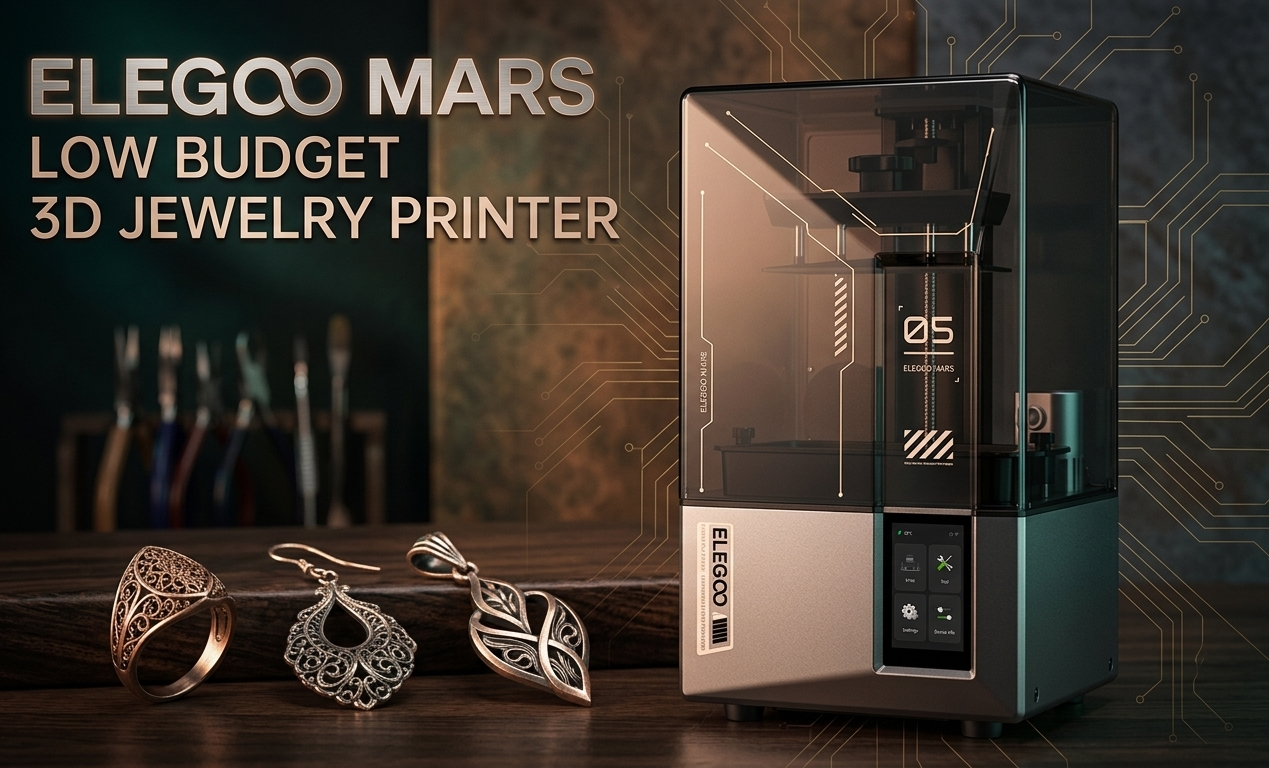
For years, high-resolution 3D printing for jewelry was the domain of expensive, industrial-grade machines. The Elegoo Mars series of resin 3D printers has shattered that barrier, offering jewelers, designers, and hobbyists an accessible yet powerful tool for creating intricate, castable patterns. These MSLA printers deliver the precision required for detailedjewelry 3D models, bridging the gap between digital CAD design and physical, ready-to-cast pieces at a budget-friendly price point.
Mars Series Evolution and Latest Models
The Elegoo Mars series has rapidly evolved, with each new generation bringing significant improvements in resolution, speed, and user experience. The journey began with the original Mars, a groundbreaking entry-level printer that made resin printing accessible. This was followed by enhanced versions like the Mars Pro, Mars 2, and Mars 3, which introduced monochrome screens for faster curing and better resolution.
In mid-2023, Elegoo launched the Mars 4 lineup, including the Mars 4, Mars 4 Ultra, and the innovative Mars 4 DLP, which uses a digital light projector for exceptional durability and precision. Looking ahead, the anticipated Mars 5 and Mars 5 Ultra, expected around 2025, promise to push the boundaries even further, likely featuring higher resolution screens, faster printing speeds, and more intelligent features tailored for professional applications like jewelry making.
Mars Model Specifications
Choosing the right model depends on your specific needs for detail, volume, and budget. Here’s a comparison of the latest and upcoming Mars models relevant for jewelry design.
| Model | Release Year | Build Volume (mm) | XY Resolution | Screen | Layer Thickness | Speed | Connectivity | Price USD |
| :--- | :--- | :--- | :--- | :--- | :--- | :--- | :--- | :--- |
| Mars 4 | 2023 | 153.36 x 77.76 x 175 | 50μm (4K) | 7" Mono LCD | 10-200μm | 30-70 mm/h | USB | $250 |
| Mars 4 Ultra | 2023 | 153.36 x 77.76 x 165 | 18μm (9K) | 7" Mono LCD | 10-200μm | up to 150 mm/h | USB, WiFi | $350 |
| Mars 4 DLP | 2023 | 132.8 x 74.7 x 150 | 50μm (2K) | DLP Projector | 10-200μm | up to 70 mm/h | USB | $450 |
| Mars 5 (est.) | 2025 | 160 x 85 x 175 | 16μm (10K) | 7.5" Mono LCD| 10-200μm | up to 180 mm/h | USB, WiFi | $400 |
| Mars 5 Ultra (est.)| 2025 | 160 x 85 x 175 | 14μm (12K) | 7.5" Mono LCD| 10-200μm | up to 200 mm/h | USB, WiFi, Cloud| $550 |
Resins & Polymers for Jewelry
The printer is only half the equation; the right resin is critical for successful jewelry printing. Different resins serve different purposes, from direct casting to creating master models.
- Castable Resins: These are the cornerstone of lost wax 3D printing. They are typically acrylic photopolymers blended with 15-40% wax content, which allows them to melt and burn out cleanly from an investment mold, leaving a perfect cavity for molten metal. They have a Shore D hardness of around 65-70D and a controlled shrinkage of about 0.8-1.0%. These properties make them ideal for direct investment casting.
- High-Detail Standard Resins: Resins like ABS-like or plant-based types are perfect for creating master models for silicone or rubber molds. With a high Shore D hardness (80-85D) and very low shrinkage (<0.3%), they produce durable, dimensionally accurate models that capture every fine detail from yourSTL or 3DM file.
- Biocompatible/Dental Resins: While less common for casting, these ISO 10993 certified resins are excellent for creating prototypes for client fittings. They offer superb detail and are skin-safe, ensuring clients can try on a model for size and feel before the final piece is cast.
Post-curing is a crucial step. For castable resins, a gentle UV cure of 2-3 minutes is often sufficient. Over-curing can compromise burnout performance. Standard resins benefit from a longer 3-5 minute cure to achieve maximum hardness.
| Name | Type | Wax % | Shore D | Shrinkage | Exposure (0.03mm) | Supplier |
| :--- | :--- | :--- | :--- | :--- | :--- | :--- |
| Siraya Tech Cast | Castable | 30% | 70D | 0.9% | 10-12s | Siraya Tech |
| Formlabs Castable Wax 40 | Castable | 40% | 65D | 0.8% | 12-15s | Formlabs |
| PowerResins CastPRO | Castable | 25% | 72D | 1.0% | 9-11s | PowerResins |
| Elegoo ABS-Like Resin | Standard | 0% | 84D | <0.5% | 2-3s | Elegoo |
User Reviews – Pros & Cons
Based on community feedback and expert reviews, here are the common advantages and disadvantages of using Elegoo Mars printers for jewelry.
Pros (✓)
- High Resolution & Accuracy: Especially on 9K models like the Mars 4 Ultra, the XY resolution allows for incredibly sharp details, essential for micro-prongs, filigree, and complex geometries.
- Blazing Speed: With speeds up to 150 mm/h on Ultra models, you can produce multiplering modelsin just a few hours, dramatically speeding up your production workflow.
- Excellent Price-to-Quality Ratio: No other printers on the market offer this level of detail and performance at such an accessible price point, making it a powerful castable resin 3D printer for small businesses.
- User-Friendly Features: Modern conveniences like auto-leveling and a resume-printing function after power loss reduce print failures and user frustration.
Cons (✗)
- Resin Odor & PPE: Resin printing involves chemicals with a noticeable odor. Proper ventilation and personal protective equipment (gloves, masks) are mandatory.
- Messy Cleanup: The process involves washing parts in isopropyl alcohol (IPA) and cleaning the build plate and vat, which can be messy.
- Firmware/Connectivity Hiccups: Some users report occasional issues with Wi-Fi connectivity or firmware bugs, though these are often resolved with updates.
- Smaller Build Volume: The compact build plate is perfect for rings, pendants, and earrings, but it may be limiting for producing very large pieces or huge batches compared to larger printers like the Elegoo Saturn.
Jewelry Printing Best Practices
Achieving perfect prints requires a combination of the right settings and techniques. A great resin 3D printer for jewelry needs a skilled operator.
Supports & Orientation
Supports are critical for success in SLA printer jewelry casting. Use numerous thin supports (0.3-0.4 mm tips) to secure the model without damaging fine details. Orienting a ring at a 30-45 degree angle minimizes layer lines on critical surfaces. For heavier pieces, consider hollowing the model to a shell of 1.5-2 mm and adding 2-3 small drainage holes to prevent resin suction and print failures.
Layer Height & Exposure
For jewelry, a layer height of 25-50 microns (0.025-0.050 mm) is standard. Always start with the recommended exposure settings from the resin manufacturer’s datasheet and perform a calibration test, adjusting by ±10% to dial in the perfect detail. Anti-aliasing can smooth curved surfaces, but it may soften very sharp details, so experiment to see what works best for your CAD designs.
FEP/PFA Film Care
The transparent film at the bottom of the resin vat is a consumable. Inspect your FEP/PFA film every 15-20 prints for cloudiness, scratches, or dents, and replace it when it’s no longer pristine to avoid print failures. The Mars Ultra models use a PFA (nFEP) film, which offers a better release force and longevity.
Temperature Control
Resins are sensitive to temperature. Maintain a stable workshop temperature of 25-30 °C (77-86 °F) for consistent results. If your resin is cold, you can gently warm it in a water bath to 35 °C before pouring it into the vat to ensure optimal viscosity.
Post-Processing Workflow
A systematic post-processing workflow ensures your 3D printed jewelry models are ready for casting.
- Wash: Submerge the print in a bath of Isopropyl Alcohol (IPA) with a concentration of ≥90%. Use a wash station or ultrasonic cleaner for 10-15 minutes to remove all uncured resin.
- UV-Cure: After drying, cure the part in a UV curing station for 2-5 minutes. Be careful not to over-cure burnout resin jewelry, as it can affect castability.
- Finish & Polish: Gently remove supports. Sand the model with progressively finer grits of sandpaper (from 400 to 2000 grit) for a perfectly smooth surface, ready for master molding or direct casting.
- Casting: For direct casting, build a tree with the printed parts, place it in a flask, and pour the investment. Follow the burnout schedule recommended for your specific castable resin (e.g., a ramp-up from 300°F to 1350°F) before proceeding with the metal casting.
Conclusion
The Elegoo Mars series, particularly the Elegoo Mars 5 Ultra and its predecessors, represents a paradigm shift for jewelers. It democratizes access to high-resolution 3D printed jewelry models, enabling rapid prototyping, custom orders, and efficient production workflows without the six-figure price tag. By pairing a high-detail printer like the Mars 4 Ultra with the correct castable resin and following best practices, even small workshops can produce professional, foundry-ready patterns that rival those from much more expensive systems.
- "Explore Elegoo Mars printers now and download our free 3D printing settings guide."
- "Compare Mars 4 vs Mars 5 Ultra features in our detailed spec table above."
- "Join our newsletter for jewelry 3D printing tips and exclusive deals."
FAQ
1. What is the main difference between the Mars 4 Ultra and the upcoming Mars 5 Ultra?
The main difference will be in resolution and intelligence. The Mars 5 Ultra is expected to feature a higher-resolution 12K screen (vs. 9K on the Mars 4 Ultra) for even finer detail, along with faster print speeds and potentially more advanced cloud-based features for remote monitoring and management.
2. What is the best resin for direct jewelry casting?
A high-wax content castable resin is best. Brands like Siraya Tech Cast, PowerResins CastPRO, or Formlabs Castable Wax 40 are excellent choices. They are specifically designed for a clean burnout during the investment casting process, which is critical for achieving a perfect metal cast with your 3D printed jewelry models.
3. Can I use a Mars printer for making master models for rubber molds?
Yes, absolutely. For this purpose, you should use a durable, low-shrinkage resin like Elegoo's own ABS-Like or similar standard resins. These produce hard, temperature-resistant models that can withstand the pressure and heat of vulcanizing rubber molds, making them a great choice for creating masters for mass production.
'''